Sam Scarlett (Samuel)

Born: 1883, Kilmarnock, Scotland
Nationality: British
Ethnicity: Scottish
Occupation: Machinist; union organizer
Migration: Immigrated to Canada 1903; then to US 1904
Affiliation: IWW
Originally a member of the International Association of Machinists, he was radicalized and joined the Industrial Workers of the World in 1911, becoming a prominent speaker and organizer reportedly arrested about 160 times. Among these arrests was his detention during the 1916 strike on the Mesabi Iron Range on murder charges that were later dropped. A defendant in the federal IWW trial of 1917–1918, he was sentenced to twenty years’ imprisonment and a $20,000 fine. His sentence was commuted in 1923 on condition of deportation, and he was deported to England in April of that year.
That August he emigrated to Canada and resumed organizing for the IWW in the Vancouver area, especially among miners. Canadian authorities attempted to deport him in 1924 using evidence supplied by US immigration officials, but the case was dropped. In 1931 he joined the Communist Party of Canada. He became an organizer for the party’s Mine Workers’ Union of Canada and was arrested in connection with the violent Estevan strike of October 1931, receiving a one-year sentence that damaged his health. Around 1938 he became chairman of the party in Toronto and of its newspaper The Clarion. When the party was outlawed in 1940, Scarlett lived underground and clandestinely entered the United States, where he remained illegally until his death in 1941.
Sources: INS file 54616/49; Industrial Workers of the World Collection, Walter P. Reuther Library, Wayne State University; Daily Worker, October 2, 1931; Donald H. Avery, “British-Born ‘Radicals’ in North America, 1900-1941: The Case of Sam Scarlett,” Canadian Ethnic Studies/Etudes Ethniques Au Canada 10, no. 2 (1978); Barbara Ann Roberts, Whence They Came: Deportation from Canada, 1900-1935.
Alexander Schatz (or Shatz; a.k.a. Harry)

Born: 1884, Kiev, Russia (present-day Ukraine)
Nationality:
Ethnicity:
Occupation: Printer
Migration: Immigrated to US 1909
Affiliation: Union of Russian Workers
Around 1917 he joined Branch No. 1 of the Union of Russian Workers in New York. A member of the editorial board of Khleb i Volia and brother of fellow URW member Boris Schatz, he was arrested during the first Palmer Raids in November 1919. During questioning he declared, “I consider myself a citizen and a laborer wherever I work and wherever I live.” He was deported aboard the Buford on December 21, 1919, leaving behind his wife and stepchild in the U.S.
Sources: INS file 54709/128.
Boris Schatz (or Shatz)
Born: 1894, Russia (probably in present-day Ukraine)
Nationality:
Ethnicity:
Occupation: Photographer
Migration: Immigrated to US 1911
Affiliation: Union of Russian Workers
In 1917 he joined Branch No. 1 of the Union of Russian Workers in New York City. He served on the editorial board of the organization’s newspaper Khleb i Volia and was the brother of fellow member and deportee Alexander Schatz. Arrested during the first Palmer Raids in November 1919, the stress of his detention reportedly caused his wife Elsie to miscarry. He was deported aboard the Buford on December 21, 1919, while Elsie remained in New York.
Sources: INS file 54709/278; FBI file OG 378924; Constantine M. Panunzio, The Deportation Cases of 1919-1920.
John Carl Schedel

Born: 1885, Munich, Germany
Nationality: German
Ethnicity:
Occupation: Piano polisher
Migration: Immigrated to US 1903
Affiliation: Communist Party of America
In August 1914 he reportedly registered with the German consulate in Cincinnati to join the German Army, yet he simultaneously became active in American radical politics, serving as county secretary of the Socialist Party of America in Fort Wayne, Indiana and later joining the Communist Party of America. Described as “a very radical socialist ” who “and “during the war caused considerable trouble at the Packard Piano Company where he his employed,” he was arrested in 1920 for declaring he would rather live in Russia “where all is freedom” than in the United States. Deported May 22, 1920, leaving behind a pregnant wife and four American-born children; shortly afterward their newborn died and his wife was temporarily declared insane.
In Germany he reportedly joined the merchant marine and then traveled to Russia, where he claimed to have joined the Red Army and worked as an interpreter near Soviet leaders. After about a year he returned to Germany disillusioned with Soviet rule. In May 1921 he stowed away from Rotterdam to New York but was ordered deported again; disembarking in England, he was jailed for a month and undertook a hunger strike. After several failed attempts he reentered the United States in 1924 via Mexico. Arrested in Chicago for unlawful entry, he was defended by the American Civil Liberties Union and pursued multiple appeals until his deportation warrant was dropped. He died in Chicago in November 1968.
Sources: FBI file OG 341493; Fort Wayne Sentinel, September 1, 1920; Garrett Clipper (Garrett, IN), July 4, 1921; American Civil Liberties Union, Annual Report, 1924; Indianapolis Star, January 21, 1925; Chicago Tribune, November 7, 1968.
Nathan Schechter (or Shechter; Shacter)

Born: 1884, Minsk region, Russia (present-day Belarus)
Nationality: Russian
Ethnicity: Jewish
Occupation:
Migration: Immigrated to US 1913
Affiliation: Communist Party of America
His wife remained in Russia when he emigrated to the United States in 1913. In September 1919 he joined Russian Branch No. 5 of the Communist Party of America in New York. Arrested in December 1919 for “criminal anarchy” and released on bail, he was arrested again during the second Palmer Raids in January 1920. He told an immigration inspector “I consider the entire capitalist system to be rotten, and it ought to be abolished,” and protested being deported as a criminal, insisting he could pay his own passage if forced to leave. After four months’ detention on Ellis Island he became a leader of protests among detained radicals and was placed in a separate cell, prompting others to threaten a hunger strike. He was deported to Russia on February 1, 1921.
Sources: INS file 54811/424.
Raffaele Schiavina (a.k.a. Max Sartin; Melchior Steele; Bruno)
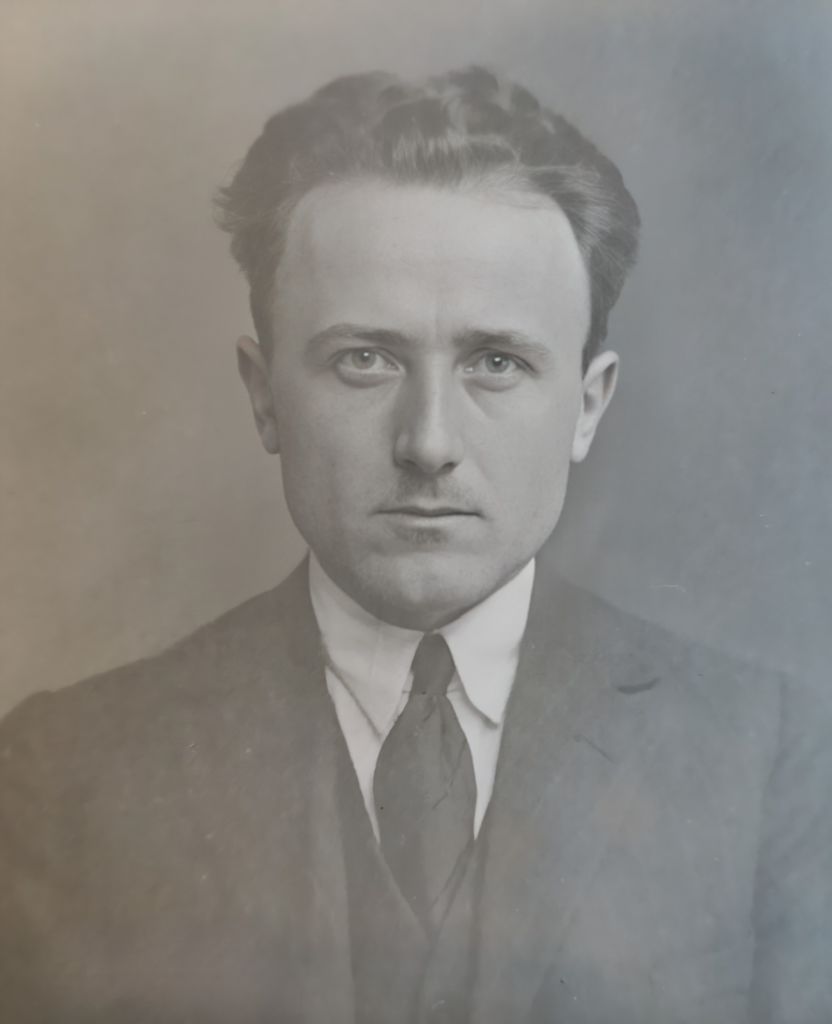
Born: 1895, San Carlo, Ferrara, Italy
Nationality: Italian
Ethnicity:
Occupation: Bookkeeper
Migration: Immigrated to US 1913
Affiliation: Anarchist
Attended an Italian business school until age nineteen and initially a socialist.
Emigrated to the United States in 1913 and became an anarchist the following year. In 1916 he became bookkeeper for Luigi Galleani’s newspaper Cronaca Sovversiva in Lynn, becoming a close associate and contributor. Arrested in 1916 for inciting to riot but acquitted, he was arrested again in 1918 for refusing draft registration and sentenced to one year in the Middlesex County House of Correction. Upon release in March 1919 he was detained for deportation and described by a federal judge as “one of the most dangerous men with whom he has had to deal.” Deported to Italy June 24, 1919, with Galleani and other associates.
Back in Italy he was briefly jailed for draft evasion, then settled in Turin, where he helped revive Cronaca Sovversiva (January–October 1920) until it was suppressed. Arrested in 1921 alongside several Communists and falsely accused of leading Turin’s paramilitary Arditi del Popolo sections, but all defendants were acquitted. In March 1923 he emigrated illegally to France; in Paris he published the anarchist newspapers Il Monito and La Difesa per Sacco e Vanzetti.
He returned clandestinely to the United States in 1928 under various pseudonyms and edited the anarchist paper L’Adunata dei Refrattari in New York and New Jersey from 1928 until 1971. He died in Salt Lake City in 1987.
Sources: INS file 54391/81; CPC busta 4690; Max Sartin, “Breve autobiografia,” Bollettino Archivio G. Pinelli, no. 13 (August 1999); Paul Avrich, Sacco and Vanzetti: The Anarchist Background; Maurizio Antonioli et al., Dizionario biografico degli anarchici italiani.
Andrew Schkurski (or Schkursky; Shkursky)
Born: 1896, Minsk, Russia (present-day Belarus)
Nationality: Russian
Ethnicity:
Occupation: Crane operator
Migration: Immigrated to US 1914
Affiliation: Communist Party of America
Became a member of the Russian Branch No. 1 of the Communist Party in Milwaukee, serving as its delegate to the party’s City Central Committee. Deported to Russia February 26, 1921.
Sources: INS file 54809/196.
Adolph Schnabel

Born: 1882, Kharkiv, Russia (present-day Ukraine)
Nationality: Russian
Ethnicity: German
Occupation: Machinist; sailor
Migration: Immigrated to US 1907
Affiliation: Union of Russian Workers
The child of German immigrants to Russia, he participated in socialist organizations in Ukraine during the Russian Revolution of 1905–1907 before emigrating to the United States in 1907.
Married Helena Ring in Philadelphia in 1913 and cofounded the Union of Russian Workers the following year, editing several of its newspapers and serving as national secretary prior to Peter Bianki. Arrested in Chicago in June 1917 for allegedly circulating anti-draft literature, the charge was dismissed for lack of evidence. He was later arrested in Duquesne, Pennsylvania for holding a street meeting without a permit. After recovering from influenza in 1919 he was arrested again in New York for deportation; released on bail, he reportedly traveled through New York and New Jersey organizing anarchist clubs. Returned to detention on Ellis Island, he participated in a hunger strike protesting conditions and was deported aboard the Buford on December 21, 1919.
His wife petitioned to be deported as well, though whether she was is unclear. In Russia Schnabel was active in anarchist organizations in Ukraine before leaving the movement; in 1931 he joined the Communist Party of the Soviet Union. Arrested in Moscow during the purges in 1937 as an alleged German spy, he was shot in a mass execution.
Sources: INS file 54616/29; Freedom (New York), October–November, 1919; Paul Avrich, Anarchist Voices: An Oral History of Anarchism in America; https://anarhia.club/forum/viewtopic.php?p=363546; https://ru.openlist.wiki/%D0%A8%D0%BD%D0%B0%D0%B1%D0%B5%D0%BB%D1%8C_%D0%90%D0%B4%D0%BE%D0%BB%D1%8C%D1%84_%D0%98%D0%B2%D0%B0%D0%BD%D0%BE%D0%B2%D0%B8%D1%87_(1882)
